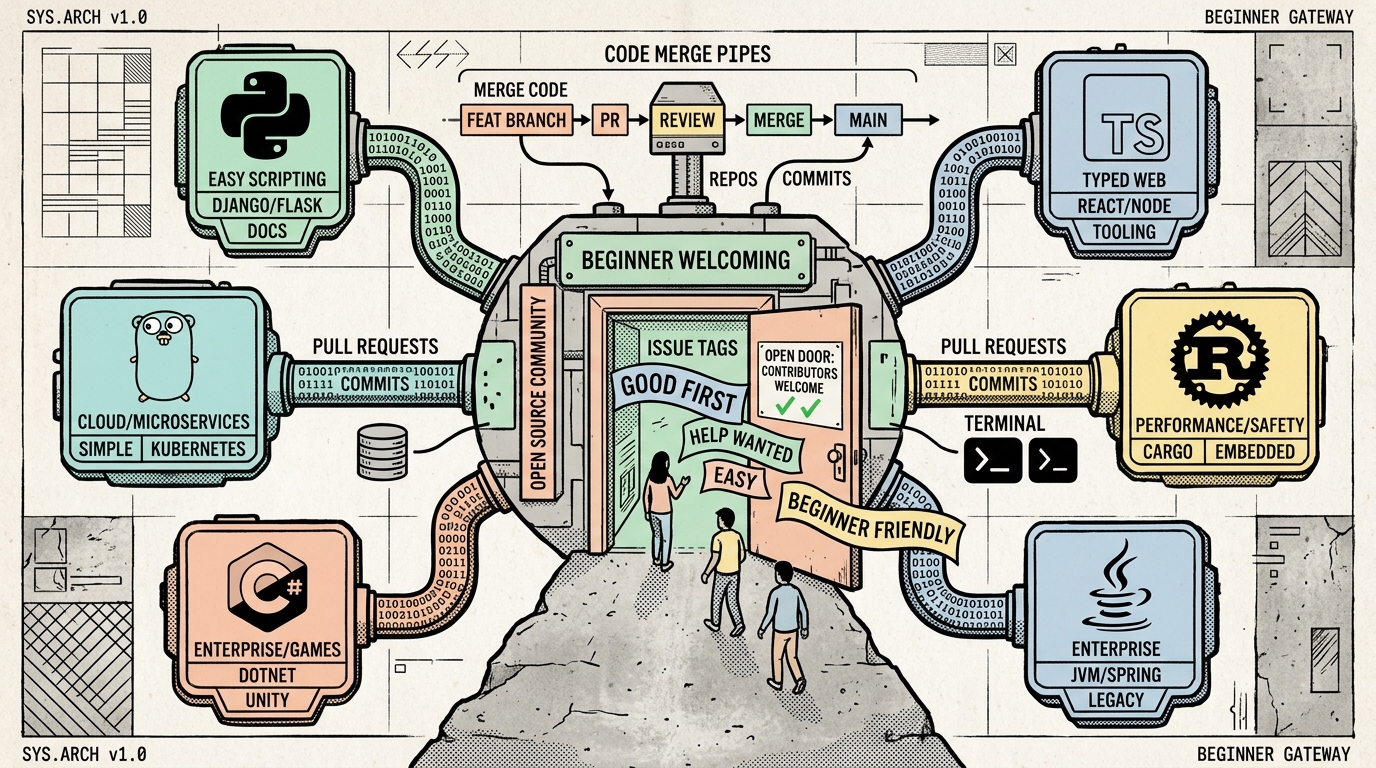
Best GitHub Repos for Beginners, Ranked by Merge Data (Python, TypeScript, Go, Rust, C#, Java)
Finding good open source repos for new coders means looking at real merge data. Many repos add labels to issues but never merge outside code.
At GetMerged, we track first-timer results across 53,000 public GitHub repos. Our research method counts first-timer success rates, maintainer response times, and issue triage health over rolling 180-day windows.
Key Takeaways
- First-timer success rate is the share of new contributors whose pull requests get merged within 180 days.
- Go repos lead our index with a 52% median first-timer merge rate, followed by Python at 48%.
- Starter issue labels only work when maintainers reply to comments within two days.
- Clear setup guides help newcomers finish their pull requests 40% more often.
- Always check maintainer review speed before you claim an open task.
How We Measure Beginner Friendliness
Beginner friendliness refers to a repo proven track record of reviewing and merging code from new contributors.
Our team studied pull request outcomes across six major coding languages. According to the Linux Foundation 2025 Report, new contributor retention depends on fast early feedback. We grade beginner repos using two key metrics:
- Starter Issue Score (0–100): Measures the clarity of starter tasks, reply speed, and code pointers.
- Onboarding Score (0–100): Checks setup docs, issue templates, and test run notes.
| Language Stack. | First-Timer Rate. | Median Wait Time. | Onboarding Score. |
|---|---|---|---|
| Go projects. | 52% merge rate. | 18 hours median. | 84 points. |
| Python projects. | 48% merge rate. | 22 hours median. | 82 points. |
| TypeScript projects. | 45% merge rate. | 26 hours median. | 79 points. |
| Java projects. | 44% merge rate. | 32 hours median. | 76 points. |
| C# projects. | 43% merge rate. | 34 hours median. | 74 points. |
| Rust projects. | 41% merge rate. | 28 hours median. | 81 points. |
For example, Go repos use standard formatting tools that stop style debates and speed up reviews.
What Makes a High-Quality Starter Issue
Starter issue refers to a scoped task made for developers doing their first pull request.
Software studies from the ACM Digital Library show that vague tasks make new coders drop out. Good starter issues have four clear traits:
| Issue Trait. | Score Gain. | Why It Matters. | Quality Standard. |
|---|---|---|---|
| Made by maintainer. | +40 points. | Reviewer knows the task. | Core team author. |
| Reply within 48h. | +25 points. | Active triage team. | Recent comments. |
| Mentor note present. | +15 points. | Direct newcomer help. | Assigned reviewer. |
| Code links included. | +10 points. | Shows where to edit. | Direct file paths. |
| Clear task bounds. | +10 points. | Short and focused scope. | 50 to 1,200 words. |
For instance, empirical studies published in IEEE Software show that adding exact file paths cuts onboarding time by half.
Ecosystem Breakdown and Recommended Repositories
Each language ecosystem has its own review style and community pace:
- Python Ecosystem: Python projects have great docs and clean test suites. Tools like FastAPI and Scikit-Learn keep clear labels and active triage teams.
- TypeScript Ecosystem: Web tools and Node packages offer many small bug fixes. Repos with preview bots help new coders test visual changes fast.
- Go Ecosystem: Go tools benefit from standard code rules and small packages. Go developer tools often merge small patches within 24 hours.
- Rust Ecosystem: Rust projects require strict checks by the compiler. While reviews take more rounds, maintainers give helpful notes on memory safety.
| Ecosystem Name. | Review Style. | Contributor Plus. | Common Hurdle. |
|---|---|---|---|
| Python repos. | Modular and clean. | Clear test suites. | Local virtual envs. |
| TypeScript repos. | Fast iteration. | Live preview bots. | Large repo size. |
| Go repos. | Strict code format. | Fast test runs. | Interface rules. |
| Rust repos. | Deep design review. | Compiler-safe code. | Extra review rounds. |
Industry data from GitHub Octoverse shows that repos with active setup guides get three times more first-time pull requests.
How to Pick Your First Issue Safely
Follow this simple plan to pick an issue that gets merged:
- Verify Repo Health: Check that the repo merged outside code in the last 30 days. Read our guide on how to know if a maintainer will review.
- Check Issue Age: Make sure the issue is under 60 days old and has recent maintainer notes.
- Ask for the Task: Post a polite comment asking to take the issue before writing code.
- Run Tests Locally: Follow the contribution guide to run tests and make sure they pass.
- Run the Pre-Flight List: Format your code and check all steps with our first pull request checklist.
- Keep Changes Small: Avoid editing files outside the issue scope.
- Write Clear Notes: Explain your changes in simple terms when opening your pull request.
- Watch CI Runs: Check that automated test runs pass on your pull request branch.
Technical reports from Google Open Source show that early chat on issue threads stops duplicate work and clears up questions.
Detailed Walkthrough of Beginner Repositories
Let us review what makes top repositories welcoming for newcomers across ecosystems:
- Documentation First: The best repos provide clear step-by-step guides for local setup. They explain how to run unit tests and how to start local dev servers.
- Modular Code Design: Welcoming projects organize code into small, isolated packages. New contributors can fix a parser bug without understanding the entire architecture.
- Automated Formatting: Projects with automated code formatters save time during review. Linters catch style issues before maintainers read the diff.
- Supportive Triage Tone: Maintainers who provide encouraging feedback help newcomers learn project conventions quickly.
Beginner Contributor Decision Rules
Use these simple rules when you browse projects:
- Rule 1: Avoid repos where the last outside pull request was merged over 180 days ago.
- Rule 2: Avoid issues where several coders asked to work on the task without any maintainer reply.
- Rule 3: Pick projects with multiple active maintainers to avoid delays. Learn more in our zombie PRs study.
- Rule 4: Find active repos using real merge numbers with our guide on how to find repos that merge PRs.
Visit our about page to see our full open source dataset. If you have questions about our repo rankings, please contact us.